Wingate's Way - Leadership Lessons From Britain's Maverick General Still Ring True Today
Dr. Simon Anglim MAJOR GENERAL Orde Wingate was the most controversial British commander of the Second World War, and can still split opinion even 70 years after his death.
Showing posts with label Special Forces. Show all posts
Showing posts with label Special Forces. Show all posts
Thursday, August 4, 2016
Wingate’s Way – Leadership Lessons From Britain’s Maverick General Still Ring True Today

Monday, May 18, 2015
5307th Composite Unit (Provisional) I

The 5307th Composite Unit (Provisional), better known as "Merrill's Marauders," had become so weakened in seizing the airfield at Myitkyina that Lt. Gen. Joseph Stilwell had to call on the 209th and 236th Engineer Combat battalions to take the nearby town.
Wingate’s exploits so impressed Winston
Churchill that the British Prime Minister summoned this “man of genius and
audacity” to the Quebec Conference in August 1943. At Quebec, the Allies
finally agreed to launch an offensive into Burma in early 1944. While the
Chinese Y Force advanced from Yunnan into eastern Burma and the British IV
Corps drove east into Burma from Manipur State, Stilwell’s Chinese-American
force would attack southeast from the Shingbwiyang area toward Myitkyina.
Capture of that key North Burma city and its airfield would remove the threat
of enemy fighter planes to transports flying the Hump and also enable the
Allies to connect the advancing Ledo Road into the transportation network of
North Burma. A new Southeast Asia Command (SEAC) under British Admiral Lord
Louis Mountbatten would provide overall control to the offensive. After
listening to Wingate’s impassioned arguments on the benefits of Chindit-style
long-range penetration groups, the Allied leaders also agreed to expand the
number of such groups to support the advance, and the Americans agreed to
supply their own long-range penetration force.
The American force which emerged, the
5307th Composite Unit (Provisional) known as GALAHAD, proved a far cry from the
elite unit which the Army’s leaders had envisioned. In the South and Southwest
Pacific, the Caribbean, and the United States, the call for jungle-tested
volunteers for a hazardous mission produced a collection of adventurers,
small-town Midwesterners, southern farm boys, a few Native and
Japanese-Americans, and a number of disciplinary cases that commanders were
only too happy to unload. As the volunteers assembled in San Francisco, one
officer remarked, “We’ve got the misfits of half the divisions in the country.”
After arriving in Bombay, India, on 31 October, GALAHAD trained in long-range
penetration tactics under Wingate’s supervision and soon earned a reputation as
an unruly outfit. A British officer, who had been invited to GALAHAD’S camp for
a quiet Christmas evening, noted men wildly firing their guns into the air in
celebration and remarked, “I can’t help wondering what it’s like when you are
not having a quiet occasion.” Although GALAHAD presented some disciplinary
problems, Stilwell and his staff were overjoyed to obtain some American combat
troops, and Stilwell managed to wrest control of the unit from the angry
Wingate. To command GALAHAD, he selected one of his intimates, Brig. Gen. Frank
D. Merrill, leading correspondents to dub the unit “Merrill’s Marauders.”
By the time GALAHAD reached the front in
February 1944, Stilwell had already started his Chinese divisions into Burma.
He had received word of Chiang’s decision to cancel the offensive into eastern
Burma but was determined to continue regardless of Y Force’s plans. Taking
command in the field on 21 December, he sent his Chinese troops southeast into
the Hukawng Valley of northern Burma. The Chinese received a major boost in
morale when a battalion of their 114th Regiment, with artillery support, drove
the Japanese from a series of pillboxes and relieved a pocket of trapped troops
at Yupbang Ga. Although a small victory, it made the Chinese believe that they
could meet the enemy on equal terms. Despite this new confidence, the advance
proceeded slowly, due to heavy seasonal rains and Chiang’s tendency to bypass
Stilwell and direct his officers not to risk their men unduly. Using wide
envelopments to outflank the Japanese defenses, the Chinese pushed to the line
of the Tanai Hka, about sixty miles into the Hukawng Valley, by late February.
With GALAHAD’S arrival on the scene,
Stilwell continued to press the advance. He ordered his two Chinese divisions
to keep pressure on the Japanese front and sent the Marauders on a wide march
around the Japanese right to cut the enemy’s communications. Once again, the
Chinese advanced at a snail’s pace, heeding Chiang’s orders to conserve
strength. Noting the glacial pace of the Chinese, Lt. Gen. Shinichi Tanaka,
commander of the Japanese 18th Division, decided to leave a force to block the
Chinese and destroy the threat to his rear.
The Marauders were living up to their image
in Stilwell’s headquarters as a modern-day version of Stonewall Jackson’s foot
cavalry. To reach the Japanese lines of communications, they needed to make
their way through jungle-choked terrain cut by frequent streams and crossed by
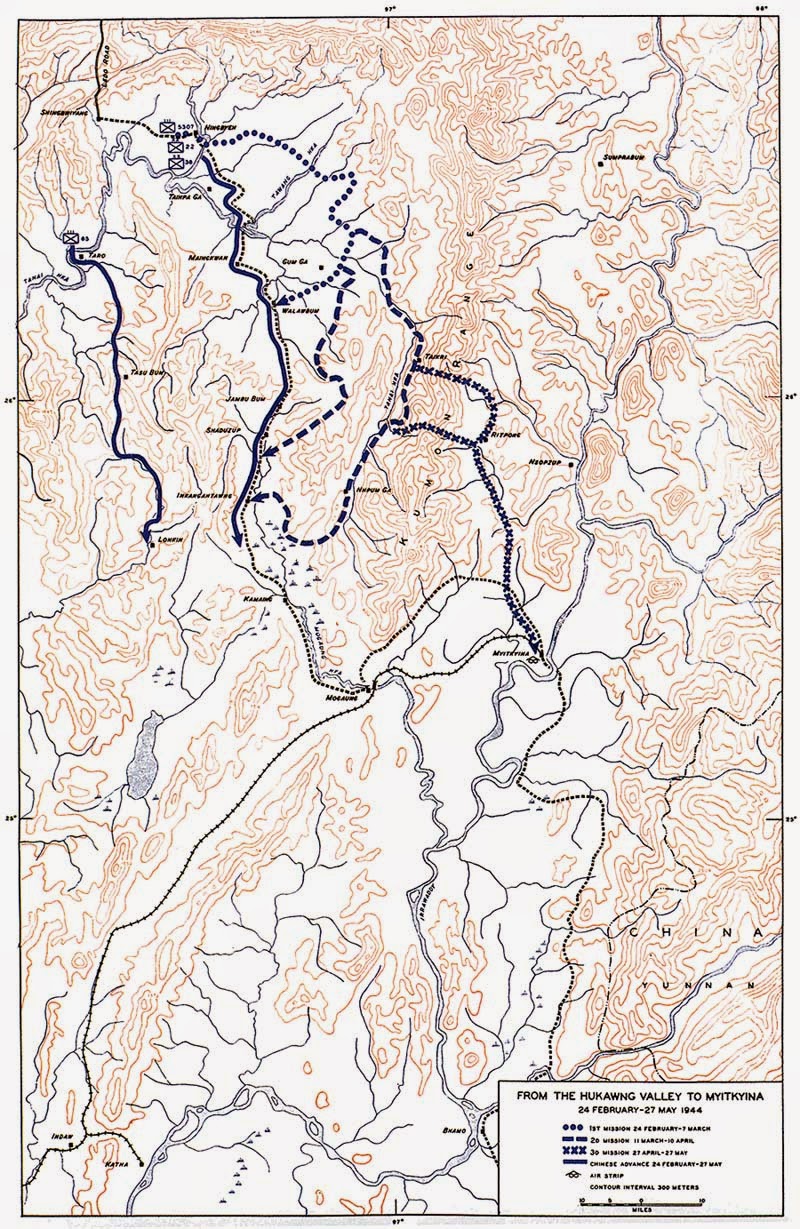
only a few trails. When the advance began on 24 February, the intelligence and
reconnaissance platoons of GALAHAD’S three battalions took the lead, carefully
probing ahead in single file on the narrow footpaths through the dense foliage,
examining footprints, stopping frequently to watch and listen, cautiously
approaching each bend in the trail. Occasionally, they clashed with Japanese
patrols. Near the village of Lanem Ga, a burst of fire from a Japanese machine
gun claimed the life of Pvt. Robert W. Landis, the lead scout of the 2d
Battalion’s intelligence and reconnaissance platoon and the first Marauder to
die in combat. On 3 March the Marauders reached the Japanese line of retreat
and established a pair of roadblocks, the 3d Battalion at the little Kachin
village of Walawbum, the 2d farther northwest near Kumnyan Ga, and the 1st in
reserve. Digging in, they waited for the enemy’s response.
The Japanese did not take long to act. At
Walawbum, the 56th Regiment struck the positions of the Orange Combat Team of
the 3d Battalion on 4 March and 6 March. The emphasis on marksmanship in
GALAHAD’S training now paid dividends as the Americans, aided by heavy mortars
firing from their rear and by two heavy machine guns, littered the fields with
Japanese dead. On the day of the 6th, the Japanese launched a banzai attack,
but the frenzied enthusiasm of the assault again proved no match for American
firepower. To the north the 2d Battalion came under severe pressure, repulsing
six attacks in one day, before Merrill withdrew them. In all, the Marauders
killed about 800 enemy soldiers at a cost of 200 of their own men. As pleased
as they were with such a performance, Stilwell and Merrill were anxious to keep
down GALAHAD’S losses, particularly given its status as the only available
American combat unit. They relieved the Marauders with a Chinese regiment on 7
March. By that time, Tanaka had decided to withdraw south along a hastily built
bypass of the American roadblocks to a strong position on the Jambu Bum, a
range of low hills at the southern end of the Hukawng Valley.
In his plan for the campaign, Stilwell had
hoped to reach the Jambu Bum before monsoon rains forced suspension of active operations.
His divisions were practically the only Allied force making progress in the
campaign. Not only had Chiang postponed Y Force’s advance, but the British, far
from moving into Burma, were trying to hold against a major Japanese offensive
into India. This Japanese advance, which began on 8 March, threatened both the
British Army in Assam and Stilwell’s supply line to India. For the moment
Stilwell could still proceed, but he would have to keep a close watch on
developments to the southwest. He accordingly laid plans for the Chinese to
continue their advance on the 18th Division’s front, while GALAHAD would split
into two parts, again envelop the Japanese right flank, and cut Japanese
communications in two different places.
In this flanking movement, GALAHAD had to
march through some of the most difficult terrain of the campaign. The Marauders
needed to climb out of the Hukawng Valley onto the hills to the east and then
move south through territory in which only the extremely steep, narrow valley
of the Tanai offered an avenue of approach. Fortunately, the Marauders in their
march unexpectedly encountered the Kachin guerrillas, who served as guides,
screened the advance, and even provided elephants as cargo bearers. On the
right the 1st Battalion hacked a path through twenty miles of bamboo forests
and streams, crossing one river fifty-six times. Early on the morning of 28
March the battalion surprised an enemy camp at Shaduzup and established a
roadblock. To the south Col. Charles N. Hunter, Merrill’s second in command,
led the 2d and 3d Battalions up the Tanai and through ridge lines to take up a
position near Inkawngatawng. They had hardly arrived when they received orders
to retrace their steps and take up blocking positions. A captured enemy sketch told
Stilwell that a strong Japanese force was advancing on the Allied left to
outflank the attackers. To head off the Japanese, the 3d Battalion occupied
Janpan and the 2d Battalion took up positions at Nhpum Ga.
At Nhpum Ga the 2d Battalion withstood eleven
days of shelling and heavy attacks from three Japanese battalions which
surrounded the position. The 2d’s perimeter, 400 by 250 yards on top of a 2,800
foot saddle of high ground, dominated the surrounding terrain, but it offered
few amenities to battalion members. The Japanese captured the only water hole,
necessitating airdrops of water into the position. The stench from rotting mule
carcasses and unburied excrement, according to one soldier, “would have been
utterly unbearable if there had been any alternative to bearing it.” Yet,
somehow, the 2d managed to hold. Its Japanese-American soldiers frequently
crept into no-man’s-land at night, eavesdropping on Japanese conversations to
discover the enemy’s intentions. Meanwhile, the rest of GALAHAD rushed to the
rescue. The 1st Battalion, leaving its position at Shaduzup to the Chinese,
hastened to the aid of the 2d, and Merrill, though evacuated with a heart
attack, arranged the drop of a pair of pack howitzers to the relief forces.
Aided by this artillery fire, the 1st and 3d Battalions finally broke through
and relieved the 2d on 9 April.
5307th Composite Unit (Provisional) II


The march to Shaduzup and Inkawngatawng and
the siege of Nhpum Ga had cost the Marauders 59 dead, 314 wounded, and 379
evacuated for wounds or illness. Of the original 3,000 men, only 1,400 were
left, and those 1,400 were approaching a state of collapse. The Marauders
anticipated a lengthy rest, but Stilwell had other ideas. The CBI chief
received assurances from the British in April that the situation to the south
was under control, but he was under pressure from the Joint Chiefs of Staff to
seize Myitkyina as soon as possible. Thus in late April, as the Marauders read
their mail, received new issues of clothing, relaxed from their labors, and
looked forward to the long rest in the rear which they believed they had
earned, “a grotesque rumor began to be heard, passed along in deprecating
tones, pretty much as a joke.” The rumor proved true. Stilwell was forming a
task force of the Marauders, two Chinese regiments, and some Kachin guerrillas
to carry out a quick overland march to seize the airfield at Myitkyina. The
American commander recognized the poor condition of GALAHAD, but he believed he
had no alternative. He promised Merrill that he would evacuate GALAHAD without
delay “if everything worked out as expected.”
Stilwell’s promise sustained the Marauders
through the grueling 65-mile march over the 6,000-foot Kumon range to Myitkyina.
Despite the efforts of an advance party of Kachins and coolies, the trail
followed by the task force proved treacherous to negotiate. Mud transformed
sections of the path into slides, and in places the Marauders had to cut steps
out of the ground for their supply mules to obtain a foothold. Even so, a
number of mules lost their footing and fell to their death. The smothering heat
and humidity, the rugged terrain, and disease caused some Marauders to drop out
of formation along the way. On 6 May advance patrols clashed with the Japanese
garrison at Ritpong, leading GALAHAD’S commanders to worry that their task had
been compromised. Nevertheless, the Marauders pressed on, finally reaching the
vicinity of the airfield on 16 May.
Despite the concerns of the commanders, the
attack on the airfield on the morning of 17 May caught the Japanese completely
by surprise. While GALAHAD’S 3d Battalion feinted toward the northern end of
the defenses and the 1st Battalion seized the Irrawaddy ferry terminal at
Pamati on the right flank, a Chinese regiment overran the airstrip and probed
toward Myitkyina itself. Lacking accurate intelligence on the defenders, this
initial attack on the city fell into confusion and was easily repulsed.
Nevertheless, exultation reigned at Stilwell’s headquarters when word arrived
of the capture of the airfield. The general made arrangements to fly in Chinese
reinforce ments and, exuberant over his success despite British skepticism, he
wrote in his diary, “WILL THIS BURN UP THE LIMEYS!”
The jubilation over the capture of the
airfield soon dissolved in the gloom of a siege. Houses and railroad cars
around the city and roads that rose twelve feet above flooded rice paddies
provided natural fortifications for the defenders, who may actually have
outnumbered their besiegers. Fortunately for the Allies, the Japanese grossly
overestimated the strength of their opponents and stayed on the defensive. To
fill gaps in the Allied line, Stilwell and his staff scrambled to find whatever
troops they could. Swallowing his pride, Stilwell requested help from the
British 36th Division, only to be informed that no troops would be available
for another two months at the earliest. Engineers and GALAHAD replacements went
into the line, frequently without sufficient infantry training. The arrival of
the monsoon and the lack of heavy weapons further slowed the operation. A
series of attacks made little headway against the defenses, and by 2 June, the
Allies had resigned themselves to a lengthy investment.
One Marauder later referred to the siege at
Myitkyina as “our little Gallipoli.” Such static warfare, with its emphasis on
fortifications and heavy weapons, ill-suited a light infantry unit like
GALAHAD, which needed relief in any case. Some Marauders cut holes in the seat
of their pants so that their dysentery would not interrupt the firing of their
weapons. On the 2d Battalion’s front, soldiers fell asleep in their trenches
from sheer exhaustion. Yet Stilwell was pressing worn units of other
nationalities onto the front at Myitkyina as well, and even using the Chindits
as line infantry. He could not relieve the only American combat troops in the
theater without raising cries of favoritism. Thus GALAHAD fought on, with
predictable results. By 25 May the Marauders were losing 75 to 100 men daily to
malaria, dysentery, and scrub typhus. Merrill himself was evacuated after a
second heart attack. Morale plummeted even further when desperate staff
officers, trying to hold down the rate of evacuation, pressed into service sick
or wounded troops who could still walk. Such episodes, along with the broken
promises of relief, confirmed GALAHAD’S sense that it was the maltreated
stepchild of higher headquarters. The resulting crisis in morale later created
a nasty scandal in the United States.
Only a few of the original Marauders
remained when Myitkyina finally fell in August. Bit by bit, the Allies, ever
improving in combat experience and close air support, had tightened their grip
on the Japanese defensive perimeter. By 17 June, GALAHAD had reached the
Irrawaddy River north of Myitkyina, cutting off the enemy from supplies and
reinforcement from that direction. Mogaung, a key rail center southwest of
Myitkyina, fell to the Chinese and Chindits on 27 June, ending any threat to the
siege from that direction. With the capture of Mogaung, Myitkyina’s fate was
sealed. Sensing the doom of the city, the defenders evacuated their wounded on
rafts, many of which were ambushed by Kachins as they drifted down the
Irrawaddy. On 3 August the Chinese attacked, sending a raiding party to
infiltrate enemy lines and create havoc in the rear while the 50th Division
made the main assault. The Japanese soon gave way, and by late afternoon the
Chinese had secured the city. Stilwell had his victory, but at a heavy price.
The campaign had cost the Chinese about 4,200 casualties, and the Americans
lost 2,200.
The fall of Myitkyina represented the
greatest victory of Stilwell’s career, but within three months he had returned
to the United States following a final quarrel with Chiang. Y Force had finally
crossed the Salween into Burma in May, but any hope of a rapid Chinese advance
toward Myitkyina soon evaporated when a Japanese counterattack drove Y Force
back toward the frontier. China’s fortunes grew even darker in August when a
Japanese offensive in east China threatened Chennault’s air bases. Chiang
wanted to withdraw Y Force from Burma, but when Stilwell notified Washington of
Chiang’s plans President Roosevelt, who had lost patience with the Chinese
leader, warned that he expected Chiang to place Stilwell in command of all
forces in China, strengthen Y Force, and press the Salween offensive. A
petulant Chiang assumed that Stilwell had instigated this humiliating dispatch
and demanded his recall. On 27 October 1944, Stilwell left the theater for the
United States. His old domain was split into two parts. Maj. Gen. Albert C.
Wedemeyer became Chiang’s new chief of staff and chief of the China theater;
Lt. Gen. Daniel I. Sultan, an engineer officer and Stilwell’s CBI deputy, took
over the India-Burma theater.
“Mars Task Force”

MULE SKINNERS AND PACK ANIMALS of the MARS Task Force plod through the hills toward the Burma Road, January 1945.


By late October 1944 it was clear that
final Allied victory in Burma was only a matter of time. In June and July the
British had decisively defeated the invading Japanese Fifteenth Army at Imphal,
removing the threat to India and opening the way for a British counteroffensive
into Burma. After Imphal the British IV and XXXIII Corps pushed to the Chindwin
River, while the XV Corps prepared to advance down the Burmese coast: General
Sultan could now call on one British and five Chinese divisions, as well as a
new long-range penetration group known as the “Mars Task Force.” This
brigade-size unit consisted of the 475th Infantry, containing the survivors of
GALAHAD, and the recently dismounted 124th Cavalry of the Texas National Guard.
The Allies possessed nearly complete command of the air. CBI’s logistics
apparatus was well established, and the leading bulldozer on the Ledo Road had
pushed to within eighty miles of the road from Myitkyina south to Bhamo. From
that point the engineers needed only to improve existing routes to the old
Burma Road, fifty miles south of Bhamo. Myitkyina had grown into a massive
supply center with an expanded airfield and a pipeline. Sensing victory, the
Allies planned to continue their advance in two phases, first to Bhamo and
Katha, then to the Burma Road and Lashio.
The offensive resumed on 15 October. While
the main British force to the southwest completed its push to the Chindwin,
Sultan advanced three divisions toward the Katha-Bhamo line. To the west the
British 36th Division, after overcoming stubborn Japanese resistance at the
railway center of Pinwe, encountered no opposition until its occupation of
Katha on 10 December. In the center the Chinese 22d Division likewise
encountered little initial opposition, occupying its objective of Shwegu
without incident on 7 November. South of Shwegu the 22d ran into advance
elements of the 18th Division near Tonkwa on 8 December. Since the 22d Division
was scheduled to leave the front for China, the 475th Infantry replaced the
Chinese and held its ground against repeated assaults until the Japanese
withdrew. Meanwhile, the Chinese 38th Division on the left flank had skillfully
used flanking movements to drive the Japanese on its front into Bhamo. After a
delaying action the Japanese evacuated Bhamo on 15 December and withdrew south
toward Lashio.
Reaching the Burma Road now lay within the
grasp of the Allied forces. The next phase of the campaign would involve a
larger role for the Mars Task Force. General Sultan wanted to send the force up
the line of the Shweli River to threaten the Burma Road and the rear of
Japanese forces opposing the advance of the Chinese 38th and 30th Divisions
from Bhamo. But the 124th Cavalry, many of whose troopers still wore the old
high-top cavalry boots, first had to make the killing hike from Myitkyina south
through the rugged mountains to the Shweli. Making their way along narrow paths
which took them from deep valleys to peaks above the clouds, the men of the
124th finally reunited with the 475th at the small village of Mong Wi in early
January 1945. From there the Mars Task Force moved east to drive the enemy from
the hills overlooking the Burma Road. Bringing up artillery and mortars, the
Americans opened fire on the highway and sent patrols to lay mines and ambush
convoys. After the experience with GALAHAD, however, Sultan and the force’s
commander, Brig. Gen. John P. Willey, were anxious not to risk the unit’s
destruction by leaving it in an exposed position astride the road.
The Mars Task Force may not have actually
cut the Burma Road, but its threat to the Japanese line of retreat did hasten
the enemy’s withdrawal and the reopening of the road to China. While Y Force
advanced southwest from the Chinese end of the Burma Road toward Wanting, the
Chinese 30th and 38th Divisions moved southeast toward Namhkam, where they were
to turn northeast and move toward a linkup with the road at Mong Yu. To oppose
this drive, the Japanese had deployed the 56th Division at Wanting, troops of
the 49th Division at Mong Yu, and a detachment at Namhkam, but these units
planned to fight only a delaying action before retreating south to join the
defense of Mandalay. They withdrew as soon as the Chinese applied pressure. As
the Marsmen were establishing their position to the south, the 30th and 38th
Divisions captured Namhkam and drove toward Mong Yu. On 20 January advance
patrols of the 38th linked up with those of Y Force outside Mong Yu. Another
week proved necessary to clear the trace of any threat from Japanese patrols
and artillery fire, but on 28 January the first convoy from Ledo passed through
on its way to Kunming, China. In honor of the man who had single-mindedly
pursued this goal for so long, the Allies named the route the Stilwell Road.
Analysis
Historians have found it fashionable to
characterize the CBI as a forgotten theater, low in the Allied list of
priorities. To be sure, the European, Mediterranean, and Pacific theaters all
enjoyed greater access to scarce manpower and material than the CBI, which had
to cope with an extended line of supply back to the United States. Only a few
American combat troops served in China, Burma, or India. Yet one can hardly
call the CBI an ignored theater. It occupied a prominent place in Allied
councils, as Americans sought an early Allied commitment to reopening China’s
lifeline so that China could tie down massive numbers of Japanese troops and
serve as a base for air, naval, and eventually amphibious operations against
the Japanese home islands. The American media, with its romantic fascination
with China and the Burma Road, followed the campaigns closely and kept its
audience informed on Vinegar Joe Stilwell and Merrill’s Marauders. Interest in
the theater did drop after early 1944 as estimates of China’s military
capability declined, but Allied leaders continued to keep a close eye on
developments in a region where they still felt they had much at stake.
For the American supply services, their
performance in the CBI theater represented one of their finest hours. The
tremendous distances, the difficult terrain, the inefficiencies in transport,
and the complications of Indian politics presented formidable obstacles to
efficient logistics. Nevertheless, by early 1944, American logisticians had
developed an efficient supply system whose biggest problem was the time needed
to ship material from the United States. The supply services expanded the port
capacity of Karachi and Calcutta, enhanced the performance of India’s
antiquated railroad system through improved maintenance and scheduling, and
developed techniques of air supply to support Chinese and American forces in
the rugged terrain of North Burma. Despite the skepticism of the British and other
observers, American engineers overcame the rugged mountains and rain forests of
North Burma to complete the Stilwell Road which, joined to the old Burma Road,
reopened the line to China. A tremendous feat of engineering, the Stilwell Road
deservedly earned considerable applause.
Stilwell himself has received more mixed
reviews. A fine tactician, he maneuvered his Chinese-American forces with
considerable skill in the campaign to drive the Japanese from the Hukawng
Valley, and he showed commendable boldness in the decision to strike for
Myitkyina before the monsoon. In the end the gamble barely paid off, but it did
succeed. Stilwell’s record indicates that he would have likely performed quite
well as a division commander in Europe, the role that Army Chief of Staff
General George C. Marshall had in mind for him before his appointment to the
CBI theater. Unfortunately, most of Stilwell’s responsibilities at the CBI
emphasized administration and diplomacy, areas for which he possessed much less
aptitude than for field command. He had little patience for paperwork, and he
lacked the tact to reconcile the differing viewpoints of the nations involved
in the CBI. Admittedly, in his three years in the theater, he probably held
more concurrent positions than should ever have devolved on one man.
In Stilwell’s record, though, perhaps no
aspect has stirred greater controversy than his treatment of GALAHAD. After the
Myitkyina campaign numerous reports appeared in the American media about a
breakdown of morale in the unit. Marauders complained that theater headquarters
seemed to view them as expendable, bastard stepchildren, not worthy of medals
or promotions. Many also protested that recruiters had told them that GALAHAD
would serve for only ninety days of combat before returning to the rear for
rest and rehabilitation. It seems clear that Stilwell and his staff could have
done more to make the Marauders feel welcome in the theater, whether through
decorations or some other means of recognition. Here Stilwell’s personality
played a key role. As a man who viewed himself as a regular doughboy, he looked
with displeasure on individuals who seemed to demand more than their fair share
of attention. When Hunter asked Merrill why GALAHAD was not receiving more
medals, Merrill replied, “Well, the boss is kind of funny about those things.”
Yet before criticizing Stilwell too harshly, one should take into consideration
the importance he placed on reaching Myitkyina before the monsoon, GALAHAD’S
status as his one reliable unit, and his inability to relieve that unit while
other equally exhausted nationalities continued to fight.
In the end, how valuable were Myitkyina and
the Burma Road? The capture of the city and the reopening of the highway
certainly made possible a vast expansion of the supply effort for China. By
January 1945, however, few American leaders cherished any illusions about a
major Chinese contribution to the defeat of Japan. In eight months the Japanese
would surrender, but any American hopes that China would become a benign,
democratic great power were soon dashed by the victory of the Communists over
Chiang’s American-equipped army in the Chinese revolution. Thus the reopening
of the Burma Road had little effect on the eventual outcome of the war and even
less on its aftermath. Nevertheless, as a story of human endurance under some
of the worst conditions to face soldiers in wartime, it holds a special place
in the annals of World War II and American military history.
Subscribe to:
Posts (Atom)